


India, now the most populous country globally, with over 1.4 billion people, boasts a youthful demographic. About one-fourth of the population is between 15 and 29 years old, while another quarter is under 14. This age distribution creates a thriving market for technology products, particularly electronics, driven by the younger generation.
Consequently, India’s electronics sector is rapidly expanding, supported by government initiatives to establish the country as a global leader. In January 2022, the government set a target of reaching US$300 billion in electronics production by 2025-26, with a strong emphasis on boosting smartphone exports.
This has helped India become the second-largest mobile phone manufacturer, housing over 200 production facilities. As consumer purchasing power grows, significant opportunities emerge for international companies to tap into the expanding Indian market.
Read More: India’s capital faces drinking water shortage after pumps flooded.
India’s smartphone manufacturing market
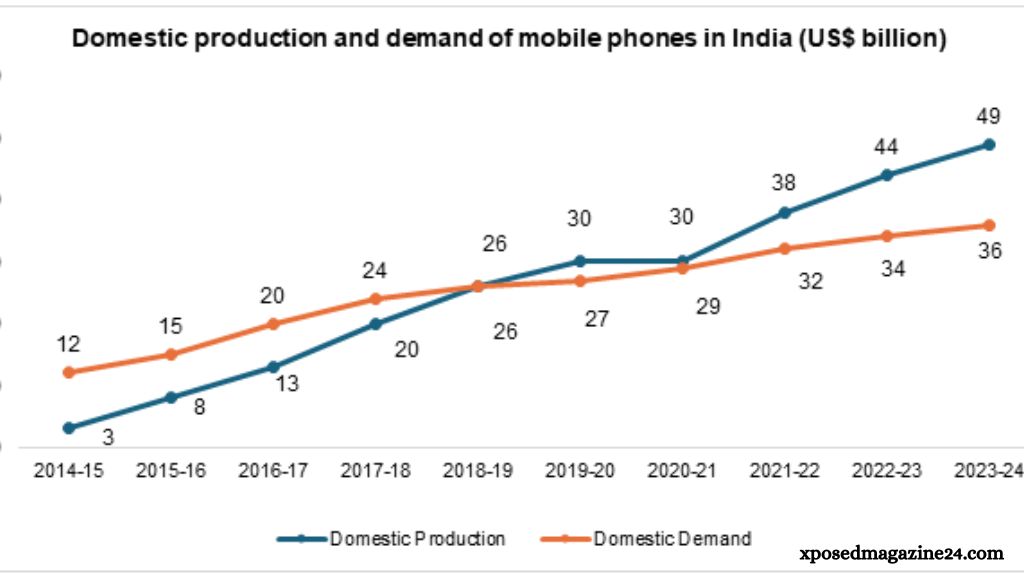
In 2014-15, India’s mobile phone production met only 25% of domestic demand. However, over the past decade, domestic manufacturing has surged, reaching Rs. 4.1 lakh crore (US$ 49.27 billion) in FY24, up from US$ 3 billion in FY15. This growth, fueled by initiatives like the Production Linked Incentive (PLI) scheme and the Make in India program, has enabled India to meet 97% of its domestic mobile phone demand.
By 2018-19, domestic production matched demand, and since the PLI scheme’s introduction in March 2020, production steadily grew from US$ 30 billion to US$ 49 billion in 2023-24. Mobile phone exports also rose by 91% in 2022-23, positioning smartphones among India’s top five exports.
According to the Ministry of Commerce, smartphone exports increased by 42% in 2023-24, reaching US$15.6 billion, up from US$11.1 billion in 2022-23. This made smartphones the country’s fourth-largest export. In 2022, India also became the sixth-largest global exporter of mobile phones. This growth supports the government’s ambitious goals for the electronics sector, underscoring the importance of continued policy support in this key industry.
Drivers of smartphone manufacturing
Government Initiatives
Production Linked Incentive (PLI) Scheme: Launched in April 2020, the PLI scheme has significantly boosted mobile phone manufacturing in India by offering financial incentives tied to production levels. This encourages manufacturers to ramp up output and invest in local facilities. Companies receive incentives one year after meeting production targets. So far, the government has disbursed approximately Rs. 2,500 crore (US$ 300.41 million) under the scheme.
Notably, Rs. 500 crore (US$60.08 million) was awarded to Samsung for meeting first-year targets, while Rs. 2,000 crore (US$240.33 million) went to Apple and Dixon’s contract manufacturers. This initiative has attracted global smartphone giants like Dixon Technologies, Foxconn, Apple, and Samsung to India, fostering competition and accelerating technology transfer to local workforces.
Phased Manufacturing Programme (PMP): Introduced in May 2017, the PMP aims to promote domestic mobile phone production. This initiative seeks to encourage large-scale manufacturing and build a robust local ecosystem. The program gradually increases tariffs to support local production, aligning with India’s goal of enhancing domestic capabilities in the electronics sector.
Make in India: Launched in 2014, the Make in India initiative has led to a significant rise in shipments of domestically manufactured mobile phones, exceeding 2 billion units from 2014 to 2022. A report by global research firm Counterpoint highlights a 23% compound annual growth rate (CAGR) in mobile phone shipments from India during this period.
China+1 Trend
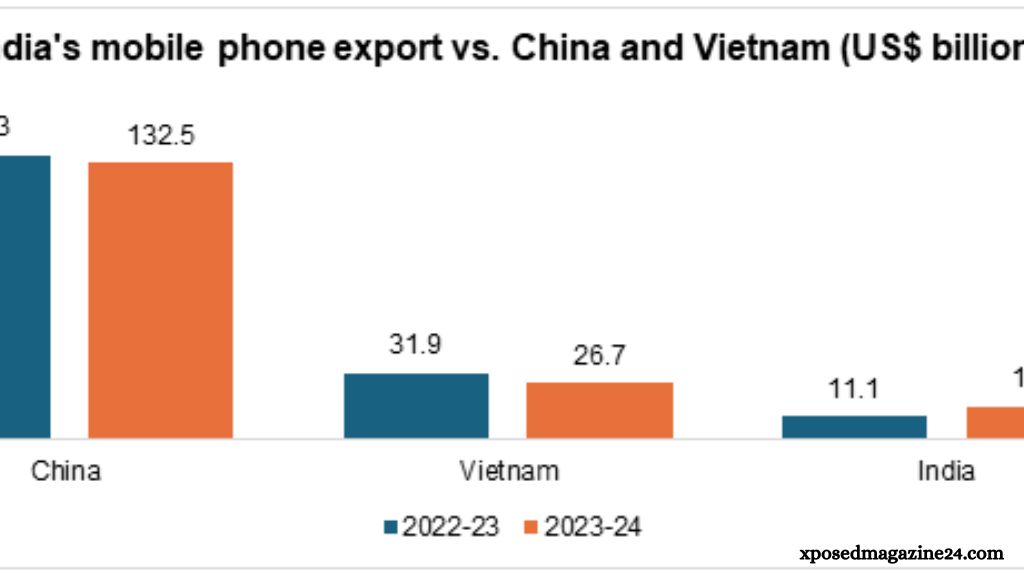
As countries seek to mitigate risks from geopolitical tensions, supply chain disruptions, and over-reliance on a single country, India has emerged as a key alternative to China for diversifying manufacturing and supply chains. The China+1 trend has significantly benefited India, particularly in mobile phone exports.
Recent trade data reveals that while China and Vietnam saw export declines of 2.78% and 17.6%, respectively, in 2023-24, India’s exports surged by over 40%. According to the International Trade Centre, China’s mobile phone exports dropped by US$3.8 billion, and Vietnam’s fell by US$5.6 billion. In contrast, India’s mobile phone exports increased by US$4.5 billion, capturing nearly half of the export declines from both countries.
Domestic Demand
India’s mobile phone manufacturing is bolstered by a large consumer base and rising disposable incomes, driving both domestic and international demand. As domestic demand grows, manufacturers ramp up production. According to the ICEA, India’s domestic mobile phone demand has increased from US$12 billion in FY14 to US$36 billion in FY24, growing at a compound annual growth rate (CAGR) of 13%.
Cost of Manufacturing
India’s cost-efficient labor significantly reduces production costs, enabling manufacturers to offer more competitively priced products. This favorable environment attracts both domestic and foreign investments, especially with government support through initiatives like the PLI scheme.
It also allows companies to scale production without incurring high expenses. The sector has created around 500,000 jobs and is projected to generate an additional 150,000–200,000 direct and indirect employment by FY25, contributing to the economy.
Global Competitiveness
India is enhancing its competitiveness in mobile phone manufacturing by increasing production scale and integrating into global value chains (GVCs). To improve supply chains, reducing tariffs on key components and sub-assemblies is essential.
The Union Budget 2024-25 has taken steps in this direction by lowering essential customs duties on mobile phones, PCBs, and chargers from 20% to 15% and exempting critical minerals and inputs for smartphone manufacturing. These measures are expected to strengthen local manufacturing and align with industry needs through simplified tariffs.
Challenges
Electronics exports are driven by global value chains (GVCs), which involve multiple assembly stages and diverse skill requirements. To boost production and exports, India needs a strategic medium-term approach that focuses on developing a robust domestic ecosystem. By fostering the necessary skills and technological capabilities, local companies can better integrate into GVCs, strengthening their position in the global market. A thriving domestic ecosystem will also enable firms and international brands to scale production and exports effectively.
India faces competition from established leaders in electronics exports, such as China and Vietnam. In 2022, electronics exports accounted for 27% of China’s total exports and 40% of Vietnam’s, compared to just 4.7% for India. This gap underscores India’s significant potential to increase electronics exports by optimizing operations. By focusing on competitive production and building a supportive ecosystem, India can capture a larger share of the global electronics market.
Road ahead
The government aims to produce US$300 billion worth of electronics by 2025-26, positioning India’s electronics sector for growth. Mobile phone manufacturing is set to contribute 40% of this target. In 2021-22, India’s mobile phone exports surpassed US$5 billion, reaching US$5.8 billion, and nearly doubled the following year. In 2023-24, exports grew by 42% compared to the previous year, continuing the upward trend.
The growth from 2021-22 to 2023-24, fueled by the PLI scheme for smartphones, has been remarkable, marking a significant boost over previous years. India has also transitioned from a position of high imports and low exports to one where exports now exceed imports annually. Government initiatives to enhance production and exports are pivotal in positioning India as a global manufacturing hub. This strategy not only supports domestic growth but also strengthens India’s competitiveness in the worldwide electronics market.
Frequently Asked Questions
What factors have contributed to India’s rise as the second-largest smartphone manufacturer?
India’s growth in smartphone manufacturing is primarily driven by government initiatives such as the Production Linked Incentive (PLI) scheme, the Make in India program, and the Phased Manufacturing Program (PMP). Additionally, cost-efficient labor, a large domestic consumer market, and increasing demand for smartphones have played key roles. Investments from global players like Apple, Samsung, and Foxconn have further fueled this growth.
How much has India’s mobile phone production grown over the past decade?
India’s mobile phone manufacturing has grown significantly, reaching Rs. 4.1 lakh crore (US$49.27 billion) in FY24, compared to just US$3 billion in FY15. Domestic demand, government initiatives, and global partnerships drive this growth.
What is the impact of the PLI scheme on smartphone manufacturing in India?
The PLI scheme, launched in April 2020, has played a pivotal role by offering financial incentives to manufacturers based on production levels. This scheme has attracted major smartphone brands to set up manufacturing facilities in India, enhancing local production capabilities and reducing the country’s dependency on imports.
What is India’s position in global mobile phone exports?
India’s mobile phone exports have grown significantly. In FY24, exports surged by 42%, and smartphones became one of the country’s top five export products. India is now the sixth-largest global exporter of mobile phones and continues to expand its share in international markets.
How does India’s mobile phone manufacturing compare to China and Vietnam?
While India’s mobile phone exports are proliferating, it still lags behind China and Vietnam, which are global leaders in electronics exports. In 2022, China and Vietnam’s mobile phone exports made up a significant portion of their total exports, while India’s mobile phone exports were about 4.7% of its total exports. However, India is catching up, benefiting from the China+1 trend and strategic government support.
How does India’s cost-effective labor influence smartphone manufacturing?
India’s relatively low labor costs make it an attractive destination for smartphone manufacturers, allowing them to keep production costs down. This cost advantage, combined with government incentives, has enabled India to scale up its manufacturing capabilities and improve its competitiveness in the global market.
What is the future outlook for India’s smartphone manufacturing sector?
With continued government support, increasing foreign investment, and a growing domestic market, India’s smartphone manufacturing sector is set for sustained growth. The government’s target of achieving US$300 billion in electronics production by 2025-26, with 40% coming from mobile phones, demonstrates a strong commitment to further expanding the sector.
Conclusion
India’s rise as the second-largest smartphone manufacturer in the world is due tostada sector strategstrategiesable labor costs and increasing global competitiveness. The country has effectively leveraged programs like the PLI scheme, Make in India, and Phased Manufacturing Program to attract global giants, boost local production, and meet domestic demand.
As India continues to expand its manufacturing capacity and export reach, its growing position in global supply chains will further solidify its role as a major player in the electronics market.

