
In July 2024, India and China agreed to de-escalate their military standoff along the Line of Actual Control in eastern Ladakh, including coordinated patrols at friction points. Despite this progress, India must continue strengthening its national power and defense readiness to address the ongoing threat from China’s military modernization and regional ambitions.
The Modi 3.0 government’s first budget, presented by Finance Minister Nirmala Sitharaman, allocated about USD 74 billion to the Ministry of Defense (MoD), a slight increase of USD 48 million from the February 2024 Interim Budget.
While this boost could support India’s Defense Budget indigenization and domestic arms production, concerns remain about whether the funding is sufficient, especially given the deteriorating global security landscape, a volatile neighborhood, and China’s growing influence.
Read More: India’s New Farm Laws: Reform, Resistance, and the Road to Reconciliation
By the Numbers
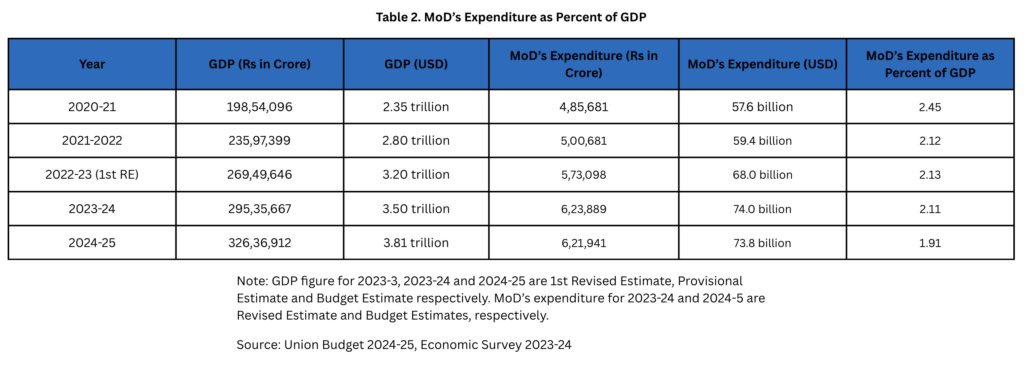
The Ministry of Defense’s (MoD) latest allocation, a modest 4.8% increase over the previous year’s budget, remains the highest among all central government ministries. However, when viewed as a percentage of India’s GDP and overall government spending, the 2024-2025 defense budget raises concerns. At just 1.91% of GDP (see Table 2) and less than 13% of the total budget, it falls short of the 3% GDP target advocated by some and represents a significant decrease from the 18% share of central government expenditure in 2016-17.

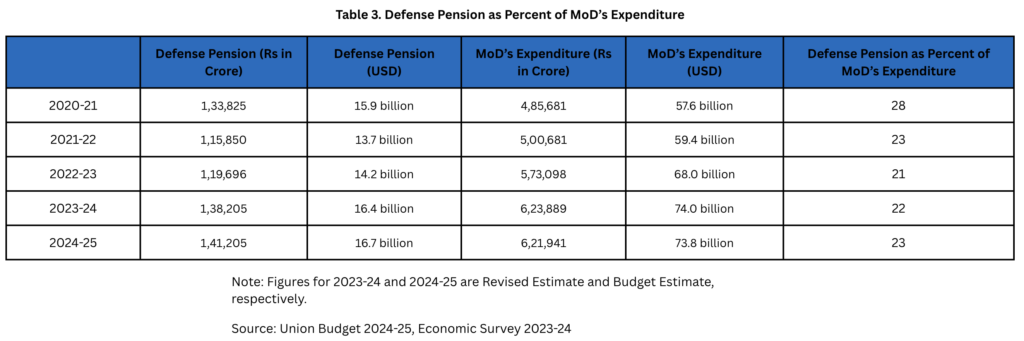
India’s defense budget is further strained by workforce costs, which have historically dominated the allocation (see Table 3). This leaves limited funds for capital expenditures, primarily intended for weapons procurement to maintain a technological edge over adversaries. Over the years, the procurement share has dwindled due to rising personnel costs. Currently, salaries and pensions consume over half of the budget (53%), with pensions alone accounting for 23%, surpassing the 22% allocated for procurement.
Winner: Indigenous Defense Industry
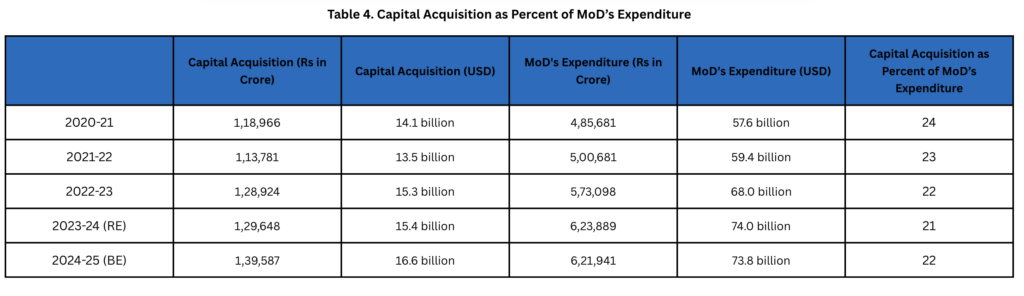
A key highlight of this defense budget is the ongoing focus on boosting domestic defense technology and building an indigenous industrial base. To support local sourcing, the Ministry of Defense (MoD) has allocated 75% of its total acquisition budget to procure from domestic industries, up from 58% in 2020-21 (see Table 4). This increased allocation will significantly benefit India’s defense sector, which stands to gain from various initiatives under the Modigovernment’s Make in India and Atmanirbhar Bharat programs aimed at enhancing economic self-reliance. Notable measures include over 500 defense items reserved for domestic manufacturing and a revised procurement manual under the Defense Acquisition Procedure 2020.
To further strengthen the technological capabilities of the domestic industry, particularly the private sector, the budget includes several strategic provisions. For instance, an additional USD 48 million allocation above the interim budget is earmarked for the iDEX program. This initiative, led by the MoD’s Department of Defence Production, supports innovation among small enterprises, startups, and individual innovastartupsth over 350 contracts and USUSD 273 million in project approvals since its inception in 2018; the additional funding underscores the program’s success continues fostering innovation in India’s defense India’sem.
The government’s announcement of a USD 119 million venture supports India’s rapidly growing space economy, which is projected to grow in the next decade. The venture will also benefit the defense industry. Additionally, the establishment of the Uaa billion corpus, introduced in the Interim Budget and reaffirmed in the July 2024 budget, aims to encourage private industry to scale up research and innovation in emerging sectors, including defense.
Loser: DRDO
While the budget introduces several initiatives to boost the private sector and enhance its research and development (R&D) capacity, it offers limited support for the Defense Research and Development Organization (DRDO), India’s premierIndia’se R&D agency under the Ministry of Defense (MoD). The Technology Development Fund (TDF), aimed at financing larger innovation projects of importance to DRDO and the armed forces, has been allocated a modest USD 7.1 million, compared to the USD 61 million earmarked for the IDX program. This signals government dissatisfaction with the TDF’s progress.
DRTDF’s budget alloDRDO, which is just 2.5% higher than the previous year, further highlights its resource challenges. Its share among the defense services—comprising the armed forces and ordnance factories—has dropped to 5.2% from a high of 6.7% in 2000-01.
This decline is concerning for India’s defense and self-reliance goals. Despite issues with delays and cost overruns in some of its projects, DRDO remains a critical player in India’s defense R&D, which is integrating both strategic and conventional weapon systems. It is central to the country’s broader innovation ecosystem, which includes private companies that rely on DRDO’s expexexpertisevernment allocates 25% of the budget to industry, start-ups, and academia, DRDO’sstartup. DRDOstartup arrested ended, faces further her r resource constraints in the future.
Mixed Progress in Defense Preparedness
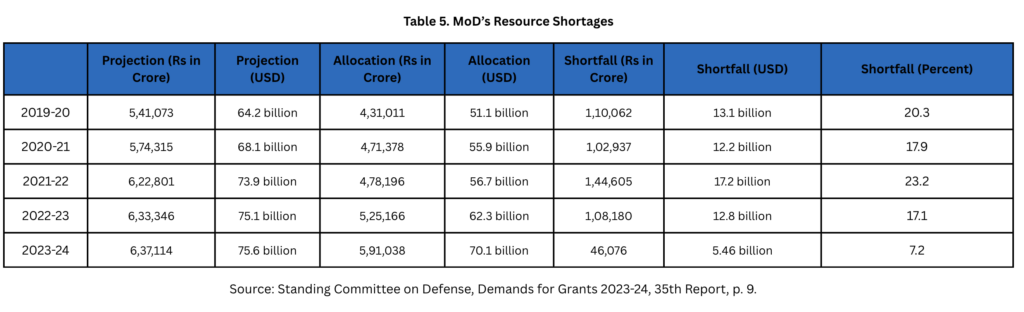
The modest year-on-year increase in defense allocations and the low share dedicated to procurement are significant factors contributing to the slow modernization of India’s industries and the growing resource gap with China, often seen as India’s strategic rival. The scale of the issue is evident, as nearly 50% of the USD 12.8 billion shortfall faced by the Ministry of Defense (MoD) in 2022-23 was due to insufficient funds for arms procurement and other capital items (see Table 5). The latest procurement budget, which is only 12% or USD 1.8 billion higher than the 2022-23 allocation, remains insufficient to bridge this resource gap.
Despite these challenges, the defense budget signals the government’s igovernment’sance border infrastructure along the India-China border, which has seen increasing Chinese aggression in recent years. The capital expenditure for the Border Roads Organization (BRO), tasked with building India’s strateIndia’sds, has risen by 30%. Some of this funding will be directed toward developing critical infrastructure along the Line of Actual Control, including the Nyoma airfield in Ladakh, the Shinku La Tunnel in Himachal Pradesh, and the Nechiphu Tunnel in Arunachal Pradesh, among other key projects.
Squaring the Circle
Given the deteriorating global security environment, the below five percent increase in India’s 202024-2Indiaudget is insufficient, especially considering the significant shortfall in the procurement budget, which is vital for maintaining technological parity with adversaries. Developing defense capabilities is a long-term process that requires substantial and continuous investment. To ensure sustained progress, India needs a double-digit increase in defense allocations for at least the next decade.
While achieving this is challenging due to resource constraints and competing demands from various sectors, India cannot afford gradual annual increases that leave significant gaps in defense modernization. From an economic perspective, India has the fiscal capacity to significantly boost defense spending, aiming to reach 2.5% of GDP within the next five years. In parallel, the government must prioritize its self-reliance agenda. Although initiatives like iDEX are valuable, the Ministry of Defense (MoD) must allocate more resources to DRDO, which is essential for advancing India’s defense ideology.
Frequently Asked Questions
What is the main focus of India’s 2024-2025 Defense Budget?
The budget emphasizes modernization, domestic procurement, and self-reliance in defense, although it faces resource constraints.
How much has India increased its defense budget in 2024-2025?
The defense budget has seen a modest increase of around 4.8% compared to the previous year.
What is the share of defense spending in India’s GDP?
The defense allocation for 2024-2025 is just 1.91% of India’s GDP, significantly lower than the recommended 3%.
How much of the defense budget is allocated for procurement?
Procurement has received a limited increase of USD 1.8 billion, but it remains insufficient to bridge the resource gap.
What role does the Defense Research and Development Organization (DRDO) play in the defense budget?
DRDO’s allocation remains relatively low compared to other initiatives despite its crucial role in India’s defense technological progress.
What steps are being taken to boost India’s self-reliance in defense?
The government has earmarked 75% of its acquisition budget for domestic procurement and enhanced initiatives like iDEX.
How is the budget addressing the India-China border situation?
A 30% increase in capital expenditure for the Border Roads Organization (BRO) aims to improve infrastructure along the India-China border.
Is India’s defense budget sufficient to meet growing security threats?
Given the global security environment, experts argue that a more significant, sustained increase in defense spending is necessary to address long-term challenges.
What challenges does India face in boosting its defense budget?
The scarcity of resources, competing socioeconomic demands, and geopolitical challenges make substantial defense spending increases difficult to achieve.
What future steps should India take for defense modernization?
India needs a sustained, double-digit increase in defense spending over the next decade to close the growing resource gap with adversaries like China.
Conclusion
while India’s 2024-2025 defense budget demonstrates some progress in areas like domestic procurement and self-reliance initiatives, it remains insufficient to meet the country’s long-term defense needs, especially in the face of rising global security threats and increasing competition from China.
The modest increase in allocations, particularly in procurement, poses challenges to modernizing the Armed Forces and achieving technological parity. To ensure a robust defense posture, India must prioritize sustained, significant increases in defense spending over the next decade while also strengthening critical agencies like DRDO. Addressing these needs will be crucial for India’s defense readiness and self-reliance in an increasingly complex geopolitical landscape.